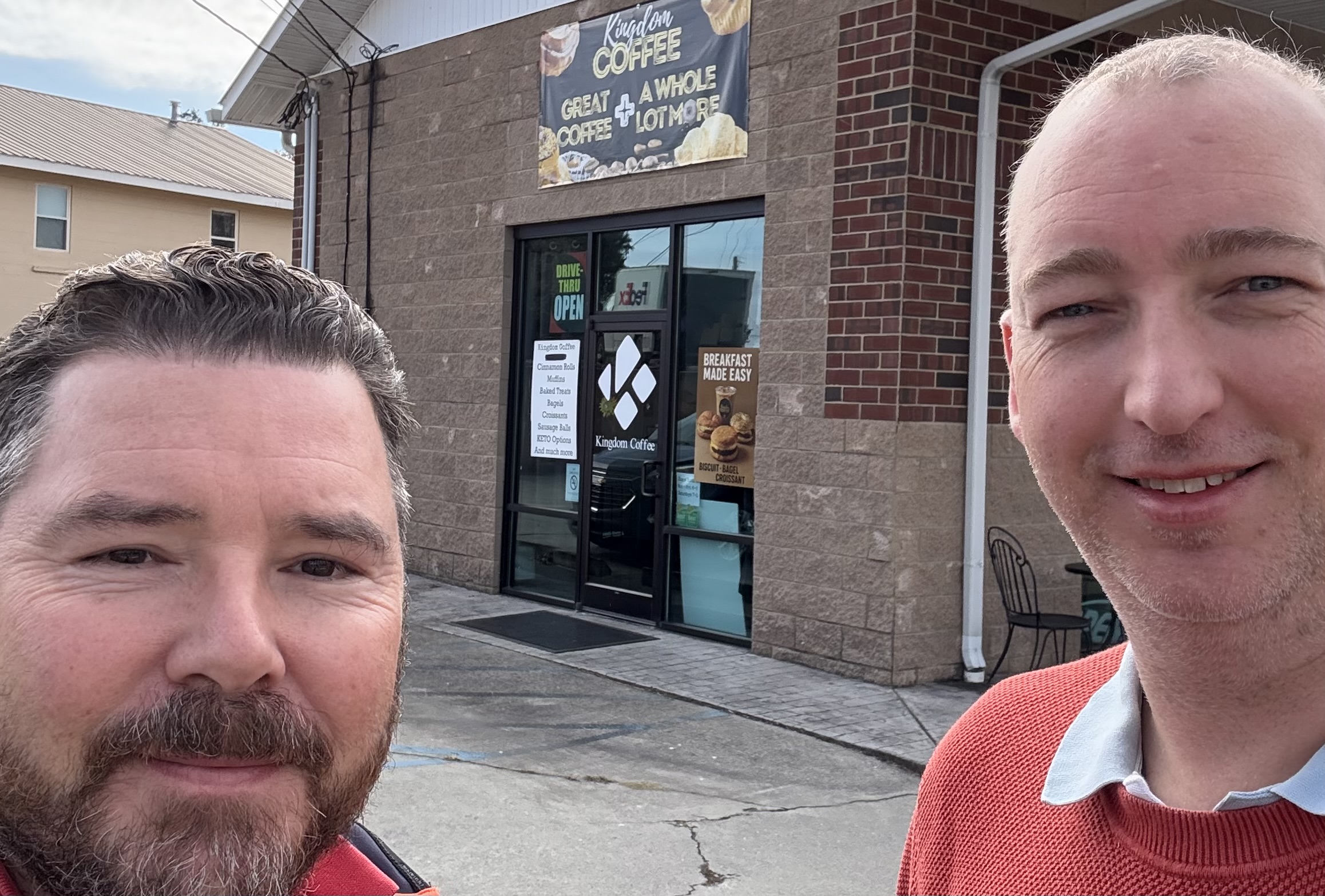
During our recent trip to the Atlanta region we spent several days meeting local entrepreneurs. One of the most insightful stops was in Chickamauga where we visited Kingdom Coffee, a family run business owned by a hardworking small business operator who has been part of the local community for years.
Conversations like these are powerful because they reveal what small business owners are really thinking about succession, value, and the future of their company. They also highlight how much uncertainty still exists around selling a business, especially in the United States where formal M&A guidance is often expensive, inconsistent, or simply out of reach for owners of companies below ten million dollars in revenue.
Our conversation with the owner of Kingdom Coffee confirmed something we had observed repeatedly. Many small business owners do not know what their company is worth. They are unsure how to prepare for a potential sale and have little sense of what the process should look like. Even more striking was the range of valuations he had seen among comparable companies in his own network. Some sold for as little as twenty five thousand dollars and others for well over one and a half million dollars. These were similar types of businesses in similar regions. Yet the outcomes varied dramatically.
.png)
What explains that difference?
Part of it comes down to preparation. Part of it comes down to timing. But a large part comes down to the process itself. Many owners simply do not have a structured way to evaluate their business, present it correctly, identify qualified buyers, negotiate effectively, and manage due diligence. Without these foundations, outcomes vary wildly.
This raises an important question. Do owners really need a traditional M&A advisor to get a fair deal Or can they take control of the process themselves with the right support
At BestBonobos we believe the answer is clear. With the right tools, structure, and guidance, most small business owners can confidently manage their own sale. In fact, many are better off doing it themselves rather than handing over ten percent of their sale price to an advisor who may not offer the depth of support they expect.
Below is a practical, step by step breakdown of how owners can prepare and execute a successful business sale themselves, often with nothing more than the help of their accountant and a clear process.
When owners think about selling their business they often picture a complex Wall Street style transaction. In reality, small business sales are far more straightforward. For companies valued below ten million dollars the steps are predictable and repeatable. Yet the industry is fragmented. Many small business owners receive inconsistent advice or feel pressured into paying high success fees without fully understanding the value they receive.
Traditional M and A firms often charge around ten percent of the transaction value. For a business selling at one and a half million dollars that is a one hundred fifty thousand dollar fee. The question is whether that fee is justified for the level of service provided. In many cases the answer is no. Especially when the owner already knows the business better than anyone else, when the buyer is often local or industry specific, and when the most valuable part of the sale is simply having a well organized process.
In our discussions with small business owners across the US we consistently hear the following concerns.
Owners feel that the fee structure is unfair.
Owners feel that they lose control of the process.
Owners feel pressured into accepting a deal that may not be ideal.
Owners feel that advisors sometimes focus more on the transaction than on the long term interests of the seller.
The owner of Kingdom Coffee echoed these concerns. He had seen firsthand how sales within his network varied dramatically depending on how prepared the owner was and how well the business was presented. The businesses that achieved higher valuations had something in common. They were organized. They had financials ready. They understood their value. They knew how to speak to buyers. Most importantly, they followed a clear process even without a full service advisor.
This is exactly where BestBonobos comes in. We believe every owner should have access to a structured, transparent, step by step approach that lets them manage their own sale with confidence.
Below is the exact process we recommend.
Small business M&A does not need to be mysterious or overwhelming. When broken into the right sequence the entire process becomes manageable and predictable. These five steps form the foundation of a successful owner led sale.
Everything starts here. A valuation is the anchor of the entire process. It determines how you position your business, how you negotiate, and what you ultimately expect from potential buyers.
Many owners underestimate or overestimate their business because they lack a structured valuation method. At BestBonobos we use a combination of EBITDA multiple analysis, industry benchmarks, and qualitative factors such as growth potential, customer concentration, recurring revenue, and owner involvement.
A correct valuation protects the owner from two common mistakes.
Selling too low because of uncertainty.
Setting the price unrealistically high and losing qualified buyers.
The owner of Kingdom Coffee understood this challenge well. The range of valuations he mentioned $25,000 to one $1.5Mio was enormous. Without a clear valuation framework it becomes almost impossible to know what is fair.
A proper valuation closes that gap instantly.
The second step is packaging your business into a clear concise document that potential buyers can digest quickly. This includes two key elements.
A one page summary that highlights the essentials.
A full information memo that includes financials, strengths, risks, opportunities, and operational details.
Buyers today are busy. They need clarity up front. A well presented memo does two critical things.
First, it shows professionalism and preparation.
Second, it significantly increases the perceived value of the business.
The businesses that sold for higher valuations in the Kingdom Coffee network almost certainly had better preparation and better documentation. Presentation is not cosmetic. It directly affects price.
Most small business owners begin with only one or two buyers in mind. That limits negotiation power and often results in a lower sale price.
Creating a long list changes everything. This list can include:
Competitors
Suppliers
Adjacent businesses
Franchise operators
Private buyers
Local investors
Regional groups expanding into the area
The goal is not to pursue them all. The goal is to identify every logical option to ensure the owner is not dependent on a single potential buyer.
In many cases the accountant or bookkeeper can help identify contacts. But with modern tools and platforms the owner can generate a long list quickly and efficiently.
Once the long list is created the owner narrows it down to a short list of the most qualified candidates. These are the buyers who have the financial ability to proceed and who show genuine interest in completing a transaction.
This step includes:
Initial outreach
Introductory calls
Review of the information memo
Basic Q and A
Initial alignment on valuation expectations
At this stage the owner selects one preferred buyer and enters the next phase. That buyer signs a simple NDA and proceeds to a Letter of Intent. The process becomes more formal but still entirely manageable for the owner.
Due diligence is where most owners feel intimidated. The term sounds complex but in reality it is simply a structured review of financials, documents, contracts, and operations. It is the final verification step for the buyer.
With a well prepared dataroom this step becomes straightforward. The dataroom typically includes:
Financial statements
Tax returns
Customer data
Supplier contracts
Lease agreements
Employee information
Operational processes
Most of this material already exists within the business. The owner and accountant simply organize it in a clean structure.
Once due diligence is complete the deal proceeds to final agreements and the sale closes. In many small business transactions this phase takes only a few weeks when the documents are well organized.
When owners follow these five steps they gain three major advantages.
They keep full control.
They save on large commissions.
They achieve more consistent and predictable results.
The owner of Kingdom Coffee understood the uncertainty in valuation. What he did not yet realize is how much of the process he could manage himself with the right structure. And this is exactly what thousands of small business owners across the United States face. They are hardworking operators. They understand their market. They know their customers. They simply need a structured path.
BestBonobos exists to provide that structure.
Standing inside Kingdom Coffee it became clear once again that small business owners deserve a better approach to selling their company. They deserve clarity. They deserve transparency. They deserve to keep more of the value they created.
The difference between a twenty five thousand dollar sale and a one and a half million dollar sale is not luck. It is preparation. It is positioning. It is process. And every owner can follow that process with the right tools.
Selling your business does not need to be confusing or expensive. You do not always need a traditional M and A advisor. In many cases you can sell your business yourself with confidence as long as you follow the right steps.
BestBonobos is built to guide you through each of these steps. Whether you are months away from selling or simply exploring your options, you can start preparing now.
Sign up for our Beta (below)and begin your journey toward a confident and successful sale.
Soon, we expect to start with a limited group of users who can test the platform. You get full functionality and give us feedback. In return, you'll soon be able to use our platform for free for six months! Feel free to sign up now to be kept up to date. You will then receive an invitation in due course: